BlogAP Biology
Cellular Respiration Explained by a Caveman (AP Biology)
6 min read
Why do you breathe harder when you run?
Why do you breathe harder when you run? Halfway up a hill, your legs are doing the climbing, but your lungs seem to have picked up a second job.
First comes the explanation a caveman would give you. Then we’ll follow the same events the way an AP Biology question expects you to explain them.
The caveman version
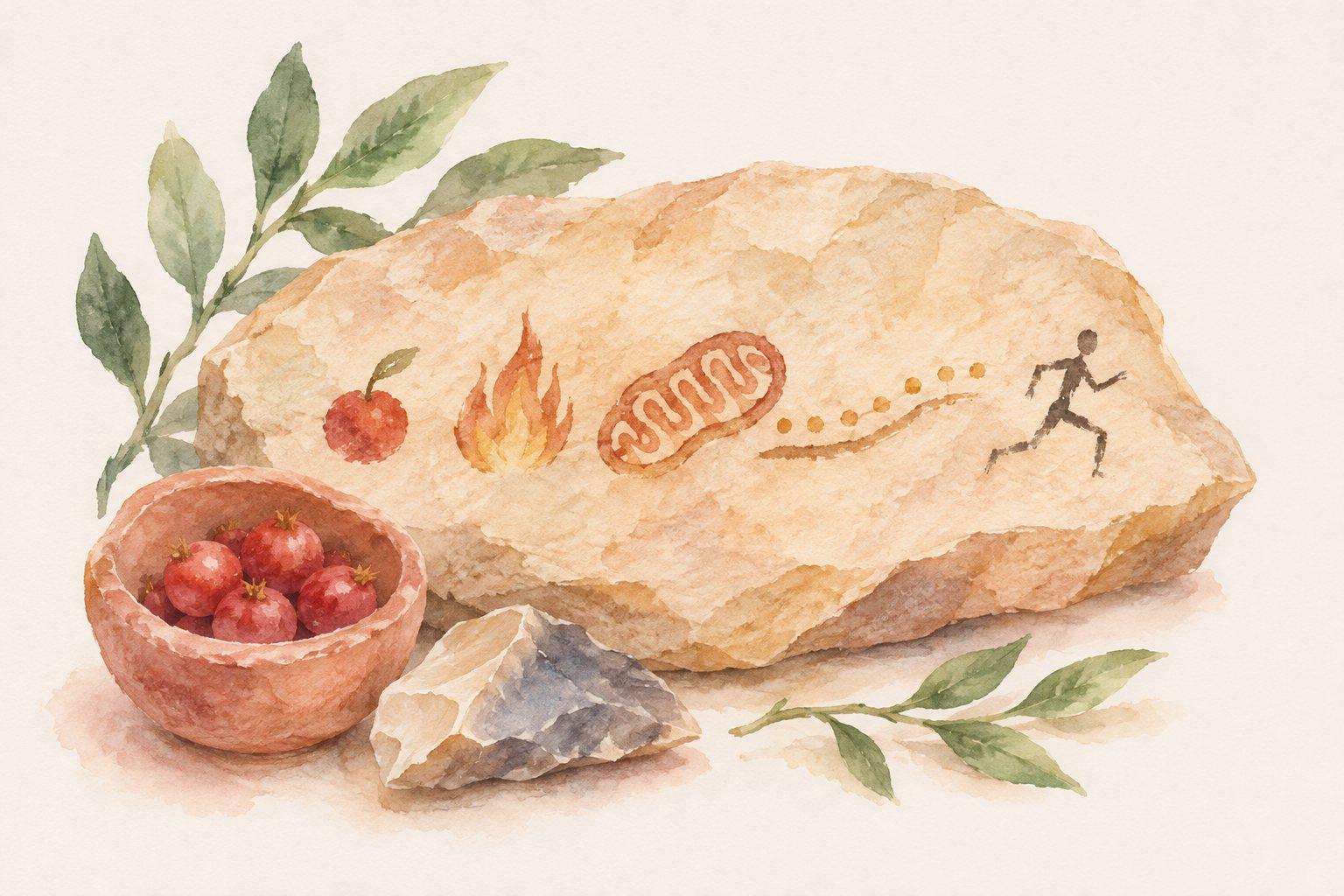
Me start with one sweet stick, six beads long. Me pay two work chips to get going. Me split sweet stick into two short sticks, three beads each. Me get four work chips back. Me count on toes. Toes say two chips richer.
Me take short sticks to back room. One bead off each goes out in a puff. Me feed each two-bead bit into round path. Each lap, two puffs go out. Along way, me catch sparks in bags.
Me pass sparks down line. Hand to hand go sparks. Last hand gives spark to breath bit. Passing sparks gives me push to pile pebbles across wall. Pebbles roll back through wheel. Wheel makes work chips. Me tribe want wheel for every hill.
No breath bit? Line jams. Me tip sparks from bag onto short stick instead. Empty bag ready to use again. Me get no work chips for bag trick. Me still get two from next sweet stick.
What the caveman meant
The sweet stick is glucose, and each bead is a carbon atom. The short sticks are pyruvate. Work chips are ATP, the molecule your muscles use to power a contraction.
The back room is the mitochondrial matrix. Each puff is carbon dioxide (CO₂). The round path is the citric acid cycle, a series of reactions that restores its starting acceptor with each turn.
The sparks are electrons, and the bags are electron carriers. One such carrier, NAD⁺, can accept electrons. Its loaded form is NADH. Tipping sparks onto a short stick represents lactate fermentation, in which pyruvate accepts electrons from NADH.
The line of hands is the electron transport chain, and the breath bit is oxygen. The pebbles are protons. They cross the wall, the inner mitochondrial membrane, and return through the wheel, ATP synthase.
The picture breaks down at the wall. Gravity pulls real pebbles downhill. What drives protons back through ATP synthase is a difference in proton concentration and electric charge across the membrane.
Glycolysis splits glucose in the cytosol
Where does the energy to build that gradient come from? Start with one glucose molecule. Glycolysis takes place in the cytosol, the fluid outside the cell’s organelles. The cell invests two ATP to add phosphate groups to sugar and prepare it to split. Both three-carbon pieces then go through the payoff reactions.
Each piece yields two ATP when phosphate passes directly from an intermediate to ADP. This is substrate-level phosphorylation. Your gross yield is 2 × 2 = 4 ATP. Subtract the investment to get 4 − 2 = 2 net ATP. Two NAD⁺ also accept electrons, giving you two NADH. All six carbons remain in the two pyruvate molecules.
Pyruvate oxidation releases the first carbon dioxide
Both pyruvate molecules now enter the mitochondrial matrix, the compartment enclosed by the inner membrane. During pyruvate oxidation, one carbon leaves each three-carbon pyruvate as CO₂. The remaining two-carbon acetyl group attaches to coenzyme A. Together they form acetyl-CoA, which carries that group into the next stage.
Follow the electrons as well as the carbon. As each pyruvate is processed, NAD⁺ accepts electrons and becomes NADH. Since you started with two pyruvates, this stage gives you two acetyl-CoA, two CO₂ and two NADH per glucose. It makes no ATP directly.
The citric acid cycle rebuilds its four-carbon acceptor
Each acetyl-CoA delivers its two-carbon group to the citric acid cycle, also called the Krebs cycle. In the matrix, the group joins a four-carbon acceptor to make a six-carbon molecule. Two carbons leave as CO₂ over one turn, and the four-carbon acceptor forms again. The carbons that leave can be different atoms from the two that just entered.
One turn yields three NADH, one FADH₂ (another electron carrier) and one ATP equivalent. One glucose supplies enough acetyl groups for two turns. That doubles the yield to six NADH, two FADH₂ and two ATP equivalents. The two turns also release four CO₂, bringing the count to six when you include the two from pyruvate oxidation.
Electron transport builds the gradient that drives ATP synthesis
The loaded carriers supply electrons to the electron transport chain in the inner mitochondrial membrane. Some proteins in the chain use energy from electron transfers to pump protons from the matrix into the intermembrane space. At the end, oxygen acts as the final electron acceptor. It takes electrons and combines with protons to form water.
Pumping builds a proton gradient. The intermembrane space has a higher proton concentration and a more positive charge than the matrix. As protons flow back through ATP synthase, the protein uses that flow to join ADP and phosphate into ATP. This coupling, called chemiosmosis, accounts for most of the ATP made during aerobic respiration.
Fermentation restores the NAD⁺ that glycolysis needs
Without oxygen to accept electrons, the aerobic chain stalls. As NADH accumulates, glycolysis can run short of NAD⁺ even though glycolysis itself uses no oxygen. Fermentation provides another destination for the electrons. For example, yogurt-making bacteria can transfer electrons from NADH to pyruvate, forming lactate and regenerating NAD⁺. All three carbons stay together.
Yeast can recycle NAD⁺ by alcohol fermentation. Each pyruvate first loses one carbon as CO₂. The remaining two-carbon molecule accepts electrons from NADH and becomes ethanol. That escaping CO₂ makes bread dough rise. In either kind of fermentation, the cell can keep earning two net ATP per glucose from glycolysis.
Common mistakes
It’s easy to leave plants out of cellular respiration because they do photosynthesis. Photosynthesis supplies sugars. Plant cells also break down those sugars through cellular respiration to make ATP.
It’s tempting to turn inhaled O₂ into exhaled CO₂ on your diagram. Draw two paths. Oxygen accepts electrons at the end of the chain and ends up in water. The carbon in CO₂ comes from glucose.
Counting two ATP for glycolysis and another two for fermentation counts the same payoff twice. Fermentation empties NADH by passing its electrons to an organic molecule. That restores NAD⁺ so glycolysis can earn its next two ATP.
Try one
A researcher supplies mitochondria with oxygen, fuel, ADP and phosphate. A drug makes the inner mitochondrial membrane leaky to protons while leaving the electron transport proteins functional. Compared with untreated mitochondria, predict what can happen to oxygen use and to ATP produced per unit of fuel. Explain both predictions.
Oxygen use can continue and may even increase because electrons can still travel down the chain to oxygen. A chain blocker would interrupt that flow. With a leak, protons can slip back into the matrix around ATP synthase. The gradient weakens, less of the return flow powers ATP synthesis, and ATP yield per unit of fuel falls.
The question tests whether you can distinguish building a proton gradient from using it to make ATP.
Back to the opening question
Running muscles spend ATP faster. Breathing harder brings in more oxygen to accept electrons at the end of the chain. That keeps electron transport and proton pumping going, so ATP synthase can supply most of the ATP your muscles need. Breathing harder also carries away more CO₂, the form in which carbon from glucose leaves during pyruvate oxidation and the citric acid cycle.
Questions
Does glycolysis happen inside the mitochondria?
Glycolysis happens in the cytosol. The pyruvate it produces can then enter a mitochondrion for further processing in the matrix.
Why do some sources say 30 ATP per glucose and others say 32?
The yield depends partly on how electrons from cytosolic NADH enter mitochondria. The 32-ATP estimate assumes an average of 2.5 ATP per NADH and 1.5 per FADH₂, giving 10 × 2.5 + 2 × 1.5 + 4 direct ATP equivalents = 32.
Which stages of cellular respiration release carbon dioxide?
During aerobic breakdown of one glucose, pyruvate oxidation releases two CO₂. Two turns of the citric acid cycle release four more.
Can glycolysis keep going without oxygen?
Yes, if NAD⁺ is replenished and fuel is available. Fermentation regenerates NAD⁺ so glycolysis can continue making two net ATP per glucose.